Identity, now in your hand.
Independent news and practical research about fingerprint smart cards for access, payments and passwordless authentication—tracking the technology beyond the press release.
New to biometric cards?
Build the basics first, compare the leading access-card approaches, then understand where powered devices fit.
How biometric cards work
Sensors, fingerprint templates, local matching, power and the questions buyers should ask.
Read the introduction → 02 · COMPARECompare access cards
IDEX, SentryCard and AuthenTrend compared by form factor, interfaces and intended use.
Open the comparison → 03 · DISTINGUISHCards versus powered devices
Why a battery-free smart card is not the same product category as PONE OFFPAD.
See the differences →A growing biometric-card library.
Follow a focused path from fundamentals to deployment, authentication, payments and market evidence.
Learn
Match-on-card, sensors, templates, privacy and the difference between passive cards and powered devices.
Start with match-on-card →Access cards
Reader compatibility, enrollment, pilots, recovery, cost and product comparison for enterprise teams.
Explore access deployment →FIDO & identity
Device-bound authentication, passkeys, PIV/PKI and the lifecycle around passwordless credentials.
Compare cards and passkeys →Payments
Payment-card architecture, certification scope and the evidence that distinguishes pilots from adoption.
Read the 2026 market guide →Three biometric cards—and one adjacent device.
We separate passive, reader-powered cards from thicker authenticators with batteries, displays and additional connectivity.
IDEX Biometrics
Fingerprint cards across access and payment use cases.
Read the profile →SentryCard
Physical and logical access bound to an on-card fingerprint.
Read the profile →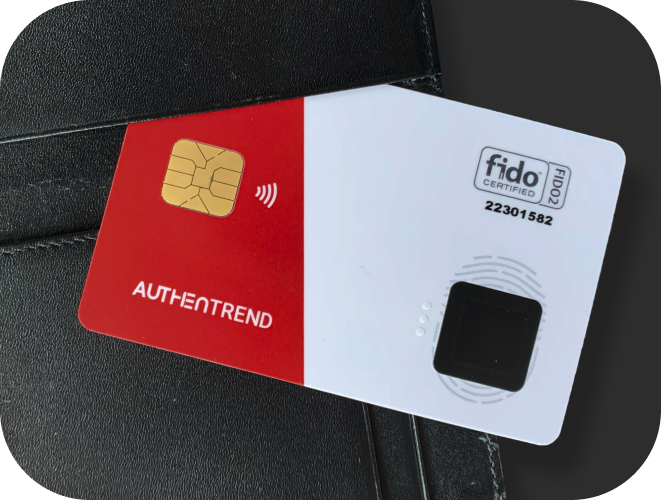
AuthenTrend
Device-bound biometric authentication in card and badge form.
Read the profile →Compare real products without misleading imagery.
See IDEX, SentryCard and AuthenTrend as biometric-card products, with PONE OFFPAD clearly separated as a powered authenticator. Every entry links back to current manufacturer documentation.
What the primary sources actually say.
Concise, independent analysis with publication dates and direct links to company documentation.
IDEX sharpens its case for one biometric card across doors and digital access
The company now presents a battery-free card spanning physical access, FIDO2 login and visual identity. Here is what is confirmed—and what buyers still need to validate.
Read report →IDEX FIDO2 Level 2 biometric card certification: what it means
IDEX says its access cards received FIDO2 Level 2 in July 2026. Here is what that adds, what remains unverified in the public register and what buyers should request.
Read report →IDEX biometric card orders, pilots and deployments: 2025–2026 tracker
Updated with the largest IDEX Access order to date: more than USD 450,000 for complete cards, with delivery scheduled from Q4 2026.
Read report →SentryCard360 extends the card story into employee identity verification
Sentry Enterprises is connecting applicant verification, card enrollment and account recovery. The architecture is broader than a fingerprint card alone.
Read report →AuthenTrend positions ATKey.Card NFC as a multi-protocol enterprise authenticator
The 0.8 mm battery-free card combines fingerprint verification with FIDO2, PIV/PKI and smart-card interfaces.
Read report →PONE OFFPAD is a powered FIDO2 device—not a passive biometric card
Official specifications confirm a rechargeable battery, E Ink display, physical button and multiple radios in a 2.5 mm body.
Read report →Get smart about the card.
Practical evergreen guides for buyers, curious readers and industry watchers.
What is a biometric card and how does it work?
A plain-English explanation of fingerprint sensors, templates, secure elements, local matching, power and real-world uses.
Read guide →IDEX Biometrics: access and payment cards
What IDEX is building, the markets it targets and the signals worth watching.
Read guide →SentryCard biometric access card: physical and logical access guide
Published capabilities, fingerprint enrollment and the checks enterprises should make before a SentryCard pilot.
Read guide →AuthenTrend ATKey.Card NFC review: FIDO2 biometric smart card
A practical review of this battery-free NFC fingerprint card: FIDO2, PIV/PKI, smart-card support, compatibility and enterprise checks.
Read guide →PONE OFFPAD and OFFPAD+: powered biometric authenticator guide
Card-sized FIDO2 devices with a battery, E Ink display, BLE and NFC—not passive biometric smart cards.
Read guide →Biometric access cards vs biometric payment cards
They may look similar, but their standards, buyers and deployment paths differ.
Read guide →What “biometric data stays on the card” really means
A useful privacy property—and the questions hidden inside the slogan.
Read guide →FIDO2 and biometric cards explained
How public-key authentication and local fingerprint verification work together.
Read guide →Biometric cards vs passkeys: security, convenience and use cases
Both can remove passwords, but they differ in hardware ownership, portability, recovery, physical access and credential lifecycle.
Read guide →Biometric access card comparison: IDEX, SentryCard and AuthenTrend
A source-based comparison of three different access-card propositions, their published capabilities and the questions buyers should test.
Read guide →Battery-free biometric cards vs powered devices: key differences
Power, charging, thickness, interfaces and operating modes compared—with IDEX, AuthenTrend and PONE examples.
Read guide →How much does a biometric access card cost?
Public list prices are uncommon. Here is how to build a defensible budget for cards, enrollment, integration, support and replacement.
Read guide →How to run a biometric access card pilot
A practical, measurable pilot plan covering readers, enrollment, users, recovery, privacy and the decision to scale—or stop.
Read guide →What is match-on-card biometric authentication?
How a smart card compares a live fingerprint with an enrolled template locally—and what buyers must verify before trusting the claim.
Read guide →Biometric card enrollment: process, privacy and failure cases
A practical guide to binding the right fingerprint to the right card without creating a weak or intrusive issuance process.
Read guide →Lost or damaged biometric card: revocation and recovery checklist
What administrators and users should do when a fingerprint card is missing, broken or must be replaced.
Read guide →Biometric card reader compatibility: what “works with existing readers” means
A layer-by-layer checklist for door readers, controllers, credentials, NFC, FIDO2, PIV and enrollment hardware.
Read guide →Biometric payment cards in 2026: technology, evidence and adoption signals
How fingerprint payment cards work, why certification matters and which signals separate a pilot from scaled issuance.
Read guide →Biometric smart cards and powered authenticators: product directory
A source-linked inventory that separates passive cards from card-sized powered devices and flags what must be verified.
Read guide →Biometric cards with Microsoft Entra ID: FIDO2 deployment guide
How a fingerprint smart card can act as a device-bound passkey for Microsoft Entra ID—and the policy, attestation, NFC and recovery checks required before rollout.
Read guide →Are biometric cards phishing-resistant or phishing-proof?
Why a FIDO2 biometric card can resist credential phishing—and why “phishing-proof” still overstates what any authenticator can guarantee.
Read guide →Biometric card pilot scorecard
A vendor-neutral scorecard for measuring enrollment, authentication, compatibility, recovery, support and cost before a wider rollout.
Read guide →Biometric smart card RFP checklist
Questions and evidence requests for comparing biometric access cards without relying on broad compatibility or security claims.
Read guide →The signal, gathered.
Recent card and authentication headlines from specialist media and the companies we track. Updated automatically from publisher feeds.
Follow our RSSHeadlines and short excerpts are attributed. Links open the original publisher. Inclusion is not endorsement.
Phishing trenger ikke ende i et datainnbrudd ↗
IDEX Biometrics · 7. september 2026 Phishing trenger ikke å ende i et datainnbrudd AI har industrialisert tyveri av innloggingsdata. Når stadig…
Phishing attempts do not have to end in a data breach ↗
AI has industrialised credential theft. Why phishing hits smaller businesses hardest, and how a fingerprint on the card makes stolen passwords worthless.…
AuthenTrend Partners with Cyphercor to Bring World-First FIDO2 Biometric Smart Card Authentication to Windows Logins ↗
Bridge the gap between physical and digital access. AuthenTrend's ATKey.Card NFC now integrates with Cyphercor's LoginTC, bringing phishing-resistant FIDO2 biometric authentication directly…
PONE Biometrics is now part of the Tech Sovereignty Catalogue ↗
The post PONE Biometrics is now part of the Tech Sovereignty Catalogue appeared first on PONE.
PONE listed on the Cyberhive EUROPE® (powered by ESCO) ↗
The post PONE listed on the Cyberhive EUROPE® (powered by ESCO) appeared first on PONE.
The End of Easy Math: Transitioning FIDO2 to PQC Standards ↗
Classical encryption is living on borrowed time. Learn how ML-DSA and lattice-based math are replacing RSA to secure the FIDO2 standard.
Why Mythos changes the authentication equation ↗
Mythos showed that AI can find and exploit software flaws faster than defenders can patch them. Why hardware-based biometrics change the equation.…
How to Securely Login on Linux Using ATKey and PAM ↗
Learn how to set up biometric authentication on Linux using ATKey.Pro. This guide covers installing libpam-u2f, configuring PAM, and enrolling your FIDO2…
Post‑Quantum Cryptography in the FIDO Ecosystem ↗
The post Post‑Quantum Cryptography in the FIDO Ecosystem appeared first on PONE.
FIDO and Passkeys: A Clear Path Beyond Passwords ↗
The post FIDO and Passkeys: A Clear Path Beyond Passwords appeared first on PONE.
New Partner – Cardelya ↗
The post New Partner – Cardelya appeared first on PONE.
New Partner – ADVI ↗
The post New Partner – ADVI appeared first on PONE.
Standards are evidence—not shorthand.
FIDO2
Protocol certification can establish interoperability and conformance. Check the listed product and certification level.
EMVCo
Payment-card evaluation supports interoperability and performance. Commercial issuance still depends on the wider ecosystem.
Common Criteria
An assurance level applies to a defined target and configuration. Read the certification scope, not only the badge.